Healer Audio Tools: Sonification Schemes for Cooperative Multiplayer Gameplay
Abstract
Competitive multiplayer video games are often a target for the optimization of gameplay. This paper investigates the potential for sonification of player-versus-environment data in boss encounters in World of Warcraft to enhance healer performance in keeping the rest of their party alive. We developed a dungeon simulator that emulated three scenarios of (1) general healing, (2) ramping damage, and (3) triage. Sonifications were mapped to data streams of party health and encounter mechanics. 4 participants were recruited to test this simulation, running through each scenario with the sonification on and with the sonification off. We found that there was a noticeable increase in quantitative healer performance when the sonifications were enabled. The user experience of the system was slightly more favorable than when the sonification was disabled. However, players’ mental models of what the sonifications represented were mixed. Due to the limited scope and sample size, this study is not generalizable, but we discuss opportunities to expand upon this research through more sophisticated system designs and alternative sonification approaches.
Keywords
Computer supported collaborative work; competitive play; esports; sonification; audio interfaces; World of Warcraft
Introduction
Background
A recurring trope of cooperative multiplayer video games is the separation of group roles into tank, damage dealers (colloquially referred to as DPS, meaning damage-per-second), and healers. Traditionally, the role of a tank is to be the defensive front line, taking the brunt of incoming enemy damage. DPS trade defensiveness for offensive capabilities, dealing damage to enemy units. Healers keep each party member’s health stable and rescue them from dangerous events. While both tanks and DPS primarily focus their attention on enemy units, the role of a healer is unique in that a healer primarily attends to friendly units.
World of Warcraft (WoW) is an MMORPG (massive multiplayer online role-playing game) from Blizzard Entertainment where the dynamic between tanks, DPS, and healers is paramount to a group’s success in running multiplayer content. Entering its ninth major content expansion in Dragonflight, some players within the community have begun to express concerns that knowledge requirements and complexity have begun to compound throughout the game’s evolution.
WoW has historically been very friendly toward the community’s development of third-party addons to modify game UI, enabling a large level of customizability supported by WoW’s extensive public Game Data APIs. A consequence of this has been an overreliance on third-party on-screen additions that have created an incentive to create arguably functional-yet-ugly interfaces that sacrifice aesthetics for information density (See Figure 1). User r/Yapyapyapyipyap on the r/wownoob subreddit puts it this way: “I kinda feel like right now I'm driving a car, but I'm spending the entire time looking at my dashboard and never looking at the road.”(Accidently took a screenshot during raid.. I didnt even realize it was this bad : wow (reddit.com)).
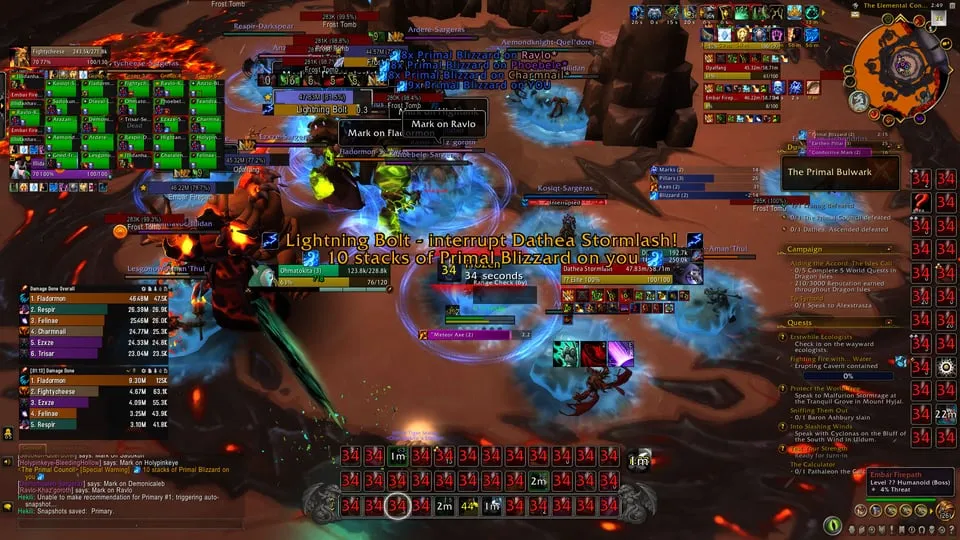
Sonification of data streams has been shown to be a promising way to rely less on our visual processing and offset information intake to another sense. Given WoW’s multifactorial streams of data present in any given encounter, along with its friendliness toward addon support and open nature of its Game Data API, I sought to develop a healer-oriented sonification to reduce visual clutter and increase the ability for healers to monitor their party health.
Research Questions
Our central research question is whether these sonifications positively affect healer outcomes with more effective performance. This research question is split into the following sub-questions:
Q1: Does the absence of sonified data hurt healer performance?
Q2: Will the sonification positively or negatively impact a player’s experience of playing their character?
Q3: Do players intuitively understand the sonifications?
Methods
This section will describe the sampling methods used, the study procedure, and the simulator design.
Participants
Overall, four participants were recruited to participate in this study. These participants were recruited through convenience sampling and pre-screened for knowledge about the “tank-support-damage” model of multiplayer combat.
Participants are college students between the ages of 19-21, consisting of three male and one female participants. All of the participants who were recruited self-identify as knowledgeable about video games, and are familiar with the role dynamics in many multiplayer action games.
The participants are anonymized and will henceforth be referred to as P1, P2, P3, and P4.
Simulator Design
Existing tools that are in use in WoW to transfer data streams from the UI to audio include boss mods like Deadly Boss Mods and BigWigs, and customization tools like WeakAuras. While these addons provide encounter-specific guides on what to do, their output is often binary and must be manually programmed for each new encounter. Considering the existing tools require significant developer overhead and are inflexible, I sought to investigate the usability of a general-purpose sonification that monitors friendly units rather than enemy-specific encounters.
To this end, I created an interactive simulation of a multiplayer dungeon setting where the user is responsible for ensuring their party is healthy. I set up three different healing scenarios to represent different kinds of encounters that a user would potentially face: (1) general healing, (2) ramping damage, and (3) triage. JSON inputs for thirty-second slices of each of these three scenarios were created to reflect these encounters.
For sonification, users hear a sine wave that begins at a low humming frequency when the party is at full health. The frequency and amplitude rise as party health diminishes. Significant damage events that are predictable are given a warning tone and a text-to-speech indicator on the affected target prior to the event occurring. Effective healing is rewarded with positive feedback from a success audio sample for topping a friendly unit above 90% health, and a danger audio sample when a friendly unit is at critical health.
Study Procedure
Participants were solicited by the researcher and pre-screened for gaming experience. Participants were notified that their session would be recorded for analysis. Verbal consent, reiterated within the recording, was used to verify inclusion within the study.
To begin, participants were given a few minutes to gain familiarity with the system’s controls. This was a within-subjects design with the order of conditions counter-balanced to account for test-retest bias. After reporting a readiness to begin, participants were randomly assigned to either execute the three scenarios with sonification off, or with sonifications on. Afterwards, participants were asked to briefly self-report their experiences using the simulator through two 7-point Likert-scale questions measuring perceived impact and perceived enjoyment. Once complete, participants were given the other condition (the no-sonification group was given sonification, while the sonification group had their sounds taken away) and asked to repeat each of the three scenarios. Finally, participants were asked to participate in a semi-structured interview, where the researcher gathered qualitative information about the participants’ experience. The full procedure is outlined in Figure 2.
Results
This section will describe the data gathered as a result of the study.
Q1: Does the absence of sonified data hurt player performance?
Originally, I intended to use a response-time reading built into the simulator as a proxy for player performance. However, I later realized that the continuous nature of the interactions meant that this was a less meaningful metric than I anticipated. Because there was always something to do in the simulation, individual changes in party health and responses to them would not be as useful as discrete reaction events.
Instead, for each participant we graphed their party’s overall health at the end of each scenario with the sonification and no-sonification conditions. The results are shown in Table 1.
| User | Scenario | Final HP (no sonification) | Final HP (with sonification) |
|---|---|---|---|
| P1Absence to Presence | 1 | 2464.3 | 2970.1 |
| 2 | 1925.2 | 2115.5 | |
| 3 | 3194.6 | 3312.5 | |
| P2Absence to Presence | 1 | 1535.4 | 1768.6 |
| 2 | 986.9 | 1181.4 | |
| 3 | 1877.3 | 1850.7 | |
| P3Presence to Absence | 1 | 2211.6 | 2166.6 |
| 2 | 1589.8 | 1570.1 | |
| 3 | 2643.3 | 2422.9 | |
| P4Presence to Absence | 1 | 3003.3 | 2979.4 |
| 2 | 2444.3 | 2349.5 | |
| 3 | 3047.7 | 2898.2 |
From the results, it appears that the suspected confounding factor of a test-retest practice effect is confounding the results somewhat, as each player tends to get better between the first set and the second set of trials independent of presence or absence of sonification.
However, as shown on Table 2, we see that even accounting for the improvements between the first and second trial, the condition where sonification was introduced afterward had an average improvement of M=202.5 while the condition where sonification was removed had an average improvement of M=92.2, implying that there is a positive improvement in healer performance when sonification is introduced. More participants are needed to see if this is statistically significant.
| No sonification, then retrial with sonification | Sonification, then retrial with no sonification | |
|---|---|---|
| Scenario 1 | 369.5 | 34.45 |
| Scenario 2 | 192.4 | 57.25 |
| Scenario 3 | 45.65 | 184.95 |
| Average Improvement | 202.5 | 92.2 |
Q2: Does the sonification positively or negatively impact the player’s user experience?
This question investigates the qualitative side of the sonification scheme – outside of actual performance, do users actually enjoy using the system?
Each participant self-reported their perceived level of impact and level of enjoyment on a 1-7 Likert scale after the sonification and no-sonification trials. The results are shown on Table 3.
| Perceived Impact | Perceived Enjoyment | ||
|---|---|---|---|
| P1 | No Sonification | 4.5 | 4 |
| Sonification | 4.5 | 5 | |
| Net Change | +0 | +1 | |
| P2 | No Sonification | 4 | 3 |
| Sonification | 5 | 5 | |
| Net Change | +1 | +2 | |
| P3 | No Sonification | 2 | 4 |
| Sonification | 5 | 6 | |
| Net Change | +3 | +2 | |
| P4 | No Sonification | 4 | 5 |
| Sonification | 5 | 5 | |
| Net Change | +1 | +0 |
Overall, the data suggest that adding the sonification slightly increased both a user’s perceived level of impact and enjoyment.
Q3: Do players intuitively understand the sonifications?
To measure this question, we interviewed participants after the trials were completed in a semi-structured format that asked the same questions, with the flexibility to ask them for elaboration when needed. To better assess this question, no briefing was given at the beginning of the study toward what sound cues would be available. Due to this, we could better interrogate the user’s mental model of what sonifications performed what functions.
Two questions were scripted for the semi-structured interview to specifically assess this, which are described here as follows:
- Did you understand what the different sonifications were communicating?
- (Follow-up) Can you tell me what sounds you think mapped to what?
- Did you find anything to be confusing about the sonifications?
- (Follow-up) If so, what did you find confusing and why?
P1 and P4 both stated that they thought the change in frequency was specifically about the tank’s health in particular, when in reality it was tied to overall party health. P1 was confused when this was clarified, saying “well, because it’s an uneven balance of health, […] so in the context of a game, the most important person to keep alive is the tank because if the tank dies then the dps are gone instantly”. P2 was able to put together a mental model that the rise in frequency was associated with an increase in danger, but did not know it was tied to party health specifically.
The text-to-speech danger warnings (of the format “Large attack aimed at [party member’s name]”) were universally recognizable by all participants. P2 stated that “oh yeah when I see that, I’m immediately on high alert, like OKAY SOMETHING BIG IS GOING TO HAPPEN, let me fix you quickly”. P3 was not pleased with the way that the text-to-speech commands were issued, saying that “the voice takes too long to actually tell me who’s in danger, and by that point I only have a little bit of time left to react”. In hindsight, a more concise warning like “Watch [party member’s name]” could give users an extra second of time to react, although there is a loss of clarity in the latter statement as opposed to the former.
Participants also universally recognized the success pings that occurred whenever a party member was healed above a certain threshold. Similarly, the danger pings that occurred when party members were below a certain threshold were understood by all participants as well. P4 said that “the way I interpret it, when I hear that fun ding I feel good and I feel like I can take my attention off that specific person”.
Overall, while there are still areas for improvement, the sonifications show a promising design space to incorporate data streams from.
Discussion
This section will synthesize the results we gathered to discuss the interpretation of these findings, limitations, and opportunities for expansion.
Interpretation of Results
Our first research question asked whether or not the sonifications positively impacted healer performance. From Table 1 and 2, we observed that even accounting for test-retest practice effects, the mean improvement for those with sonifications introduced (M=202.5) was noticeably more than those with sonifications removed (M=92.2). The significance of this is that sonifications are positively impacting healer performance in these scenarios, which opens a larger design space for adopting and iterating upon these systems for a larger audience.
Our second research question asked whether or not the player’s user experience was positively or negatively affected by the sonifications. From self-report measures on perceived impact and perceived enjoyment (see Table 3), none of the participants reported that the introduction of the sonification lessened their perception of impact or enjoyment. Net changes trended toward the positive end of the scale, although P1 reported no change in perceived impact and P4 reported no change in perceived enjoyment. Overall, it appears that the sonification marginally increases the user experience of healing, although more data is needed to understand if this is statistically significant.
Our third research question asked if players intuitively understood the sonifications without being given a tutorial. Our findings from this question generated mixed results. Users generally created mental models of the sonifications that approximated what they were actually meant for but were not entirely accurate. The change in frequency meant for representing overall party health was misconstrued as being for one party member’s health. Text-to-speech indicators were understandable but not actionable due to the way they were implemented. The amount of time it took to fully say a message gave users very little agency to respond immediately to events, and suggestions were provided to shorten the messages to make them more concise. The success and danger pings were understood, although the thresholds felt somewhat arbitrary for users.
Strengths and Weaknesses
Overall, the data we collected from our participants suggest that the sonification design scheme used for facilitating healer performance is positively impacting healer performance in the 4 participants we studied. Due to the extremely limited sample size for this study, we cannot generalize whether this holds true for a broader population.
Because this was a class project, limitations of project scope and timeline also affected the realism of the simulator. Given more time and resources, more could be done to ensure the simulator’s scenarios ran more realistically, and that the display on screen could properly mimic the visual elements involved within an enemy encounter.
Future Research
Practical implications of this sonification scheme include usage in competitive play as a method of relieving the visual overhead necessary to keep track of high-end competitive encounters. While we were unable to generate statistically significant results due to the limitations of our study, we recommend further research with larger sample sizes and more sophisticated simulations to better replicate the usage of this sonification in more realistic scenarios.
Additionally, future research could investigate alternative methods of sonifying data streams. One piece of feedback given by participants was that they’d like to be able to ambiently track all five party members at once. Figuring out a way to represent five continuous sources of data and tell them apart is a sonification challenge, but a useful sonification that can independently represent these sources clearly could enhance the usability and understanding of the system.
Conclusion
Sonification for multiplayer games like World of Warcraft presents an interesting design space for optimizing play on the competitive end. The sonification scheme we devised shows potential for enhancing healer performance but requires a larger and more sophisticated study to truly interrogate the impact.